 Trusted Service
 30 Day Return Policy
 2 Year Warranty
 Worldwide Delivery
 Most UK bats can't be reliably identified by sight alone. In flight, at dusk, from a distance, several species look almost identical: small, dark, fast, and gone before you've had a proper look. Reliable bat identification isn't usually about watching more closely. It's about listening.
Every UK bat species echolocates at its own characteristic frequency and rhythm, effectively a distinct acoustic signature. With the right equipment, you can identify a bat you've never even seen clearly, purely from the sound it's making to navigate in complete darkness.

Why bat identification by sight alone usually isn't enough
A few things help narrow things down visually: size, flight style, and habitat all give clues. Noctules fly high and fast in open sky, often visible well before full darkness. Pipistrelles flit low and erratically around trees and streetlights. Horseshoe bats have a distinctive, fluttering flight close to vegetation. But these are broad patterns, not certainties, and several species overlap enough that visual identification alone rarely holds up to real scrutiny.
The genuinely interesting part: bats have distinct voices
Bats navigate and hunt using echolocation: they emit rapid pulses of sound, mostly far too high-pitched for humans to hear, and interpret the returning echoes to build a picture of what's around them, down to the size and movement of a single flying insect.
What makes this useful for identification is that different species call at different peak frequencies and patterns. A common pipistrelle calls at roughly 45kHz. A soprano pipistrelle, despite looking almost identical, calls at around 55kHz. A noctule calls much lower, around 18 to 27kHz, loud enough that some people with young ears can just about hear the lowest edge of it. Horseshoe bats sit at the opposite extreme, calling at a piercing 80kHz upward, in a smooth, warbling tone rather than the sharp clicks most other species produce.
None of this is audible to the human ear without help. That's where a bat detector comes in: a device that picks up these ultrasonic calls and converts them into something you can actually hear. A heterodyne bat detector shifts one chosen frequency band down in real time, quick and simple but limited to listening to one part of the spectrum at a time. Broadband and full spectrum detectors capture the whole call, then use frequency division or time expansion, and increasingly dedicated sound analysis software, to slow it down or convert it for playback and closer inspection afterwards. Either way, the effect is the same: translating a bat's private conversation with the dark into something a person can listen to and compare.
What else helps confirm a species
Frequency is the starting point, not the whole answer. A few other things ecologists and experienced bat enthusiasts factor in:
- Call rhythm and repetition rate, since some species call in a steady, evenly spaced pattern while others are more erratic
- Habitat, since certain species are strongly associated with woodland edges, water, or open farmland
- Timing of emergence, since species vary in how soon after sunset they typically appear
- Roost type and location, which can rule some species in or out entirely depending on the structure involved

This is also why frequency ranges overlap between some species. A bat calling around 45kHz could plausibly be a common pipistrelle, but without other context, that frequency alone isn't a confirmed identification.
The species you're most likely to be trying to place
The UK has 18 resident bat species, and a handful come up again and again once you start paying attention. Beyond the common and soprano pipistrelle already mentioned, Daubenton's bat (Myotis daubentonii) hunts low over water with a distinctive fluttering flight. Brandt's bat (Myotis brandtii) and Bechstein's bat (Myotis bechsteinii) are both harder to separate from other Myotis species acoustically, and are often confirmed by call analysis software rather than ear alone. Nathusius' pipistrelle (Pipistrellus nathusii) looks near-identical to its two more common pipistrelle relatives but calls at a noticeably lower frequency. The brown long-eared bat (Plecotus auritus) is one of the UK's quietest species, sometimes called a whispering bat, while its much rarer relative, the grey long-eared bat (Plecotus austriacus), is confined to a handful of sites in southern England and is one of the country's rarest mammals.
For licensed bat workers handling a bat safely in the hand as part of monitoring or ringing work, under a licence: physical measurements like forearm length and wingspan add another layer of confirmation, sometimes cross-checked against a dichotomous key, a step-by-step chart of paired either-or questions used to narrow down a species. That level of hands-on identification isn't something to attempt yourself though, all UK bats are legally protected, and handling one without a licence is an offence.

Going further
If you want the specific frequency ranges for each UK species, or you're already using a detector and want to know what you're likely hearing, our bat echolocation frequencies guide breaks it down species by species. Many reference call libraries also include recorded audio samples alongside the technical detail, worth a listen if you want to train your ear before you're relying on identification in the field.
Getting species identification right isn't just satisfying for its own sake either. Data gathered this way feeds into national efforts like the National Bat Monitoring Programme, which tracks population trends across the country and depends on accurate species-level records from both professional surveyors and enthusiasts alike.
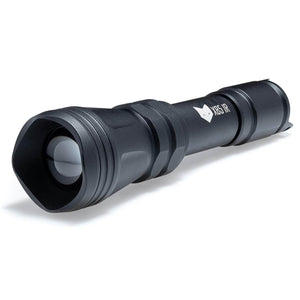
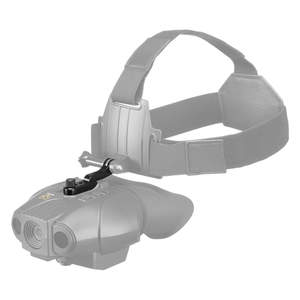
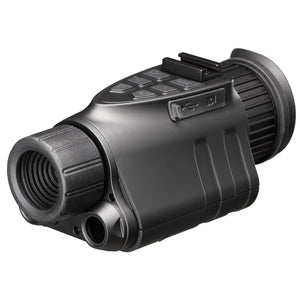
Pairing sound with sight makes the whole thing far more satisfying, hearing a call and then actually watching the bat making it. A wildlife-watching night vision device, like the Nightfox Whisker, lets you do exactly that without disturbing the bat with visible light, turning a sound you can barely place into a bat you can actually watch in flight.
FAQs
How does bat identification work? Most reliably through their echolocation calls, since different UK species echolocate at distinct peak frequencies and patterns. Visual clues like size, flight style, and habitat can help narrow things down, but rarely confirm a species on their own.
Can you identify a bat without a bat detector? To some extent, using size, flight pattern, and habitat, but many UK species look similar enough in flight that a confident identification usually needs an acoustic detector to pick up the echolocation call.
Why do bats echolocate at different frequencies? It's thought to relate to a species' hunting style, prey size, and habitat. Higher frequencies typically carry less distance but give finer detail on small, close prey, while lower frequencies travel further, suiting species that hunt in more open spaces.
Can humans hear any bat calls at all? Almost none. Most UK bat calls sit above roughly 20kHz, the upper edge of human hearing, though the lowest part of a noctule's call occasionally brushes the very top of what some younger ears can detect.
Do ecologists use physical measurements to identify bats? Yes, but only when a bat is safely in the hand under an appropriate licence, since handling bats without one is illegal. Measurements like forearm length and wingspan are sometimes checked against a dichotomous key alongside acoustic data, particularly for species that are hard to separate by call alone.