 Trusted Service
 30 Day Return Policy
 2 Year Warranty
 Worldwide Delivery
Whales and dolphins spend almost their whole lives underwater, and in the dark you can't see them at all. So when Dan Harris set out to answer one question off the Isle of Mull, can you film cetaceans with a thermal camera even when you can't see them, the answer wasn't obvious.
It turned out to be yes, twice over: a common dolphin spotted 500 metres away in the dark, and, the next day, a humpback whale picked up by the thermal camera just under a kilometre out at sea.
Why a thermal camera can find whales and dolphins
Whales and dolphins are warm-blooded, and the sea is cold, so there's plenty of temperature difference for a thermal camera to pick up. The catch is that water blocks thermal imaging, so the camera can only see what breaks the surface: the animal's back or fin, and the warm breath of its blow.
Researchers already use thermal imaging this way. Ship-mounted systems have picked up whale blows at night at distances of between 1.5 and 3km in polar waters. Those are cooled, professional-grade imagers, so a handheld camera won't match that range, but it shows the principle works.
Dan's plan was to wait for the air temperature to drop, to make the contrast as strong as possible. Conditions do matter, though they may matter less than you'd expect: an analysis of around 1,900 whale blows and bodies found that the thermal contrast stayed roughly constant regardless of sea temperature.
Camping on the clifftop
The night session began on a tiny island off the coast of Mull. Dan pitched a bivvy on the cliff edge, sheltered from a windy evening, and waited for it to get dark.
While he waited, there was another question to answer: do whales and dolphins sleep at night? They do, but not like we do. Every cetacean scientists have studied so far rests one half of its brain at a time, keeping the other half alert to watch for danger and to keep surfacing to breathe. Dan notes that in some parts of the world, whales and dolphins are known to be very active at night, and he wanted to see whether the same was true in Scotland.
A dolphin in the dark
It was pitch black on the water. After an hour of searching with the thermal camera, something appeared about 500 metres away. Judging by its long dorsal fin, Dan identified it as a small common dolphin, and without the thermal camera, he'd have had no idea it was there.
That answered half the question. Thermal could find a dolphin at night. What about in daylight, with glare on the water and warmer temperatures to contend with?

Out on the Sound: birds, dolphins and gannets
The next day, Dan joined a wildlife boat trip from Tobermory with Sea Life Mull, heading out into the Sound of Mull and deeper water.
About an hour out, a large raft of seabirds on the water caught his eye: guillemots, puffins, razorbills and Manx shearwaters, with an Arctic skua overhead, a seabird known for chasing others until they drop their catch. Seabirds feeding at the surface are a good clue that there's food underneath, and often the animals hunting it.
Then came the first dolphins of the day, large common dolphins just off the back of the boat. Common dolphins have become much more common around the Hebrides. By 2018, researchers had recorded a twenty-fold increase in sightings since 2003, and they're now among the most commonly seen dolphins in the area. Nobody knows exactly why, but warming seas may be part of it, as the Hebrides sit near the northern edge of their range.
Something huge on the thermal
While filming diving gannets, Dan noticed something strange ahead and picked up the thermal camera. Just under a kilometre away, it showed something massive. Moments later, the group saw the fluke of a humpback whale lift out of the water as it dived, and then the whale came back up to the surface and blew.
Humpbacks are around 13 to 15 metres long and weigh 25 to 40 tonnes, which is why such a large heat signature stands out against cold water. They usually dive for several minutes, though sometimes far longer, and nearly always raise their flukes before going down. The pattern on the underside of the fluke is unique to each whale, which is how researchers tell individuals apart.
North Atlantic humpbacks breed in the warm waters of the Caribbean over winter and migrate thousands of miles to feed in colder northern waters in summer. They eat mainly krill and small schooling fish such as herring and sand eels. Sightings around Britain and Ireland have increased markedly in recent years.
What whales eat, and what's changing in the plankton
Also on the boat was Andy Tate, who has been documenting marine life around Mull for about 30 years, from fin whales to thresher sharks. Sea Life Surveys, now Sea Life Mull, was already sampling plankton in 1993, and Andy has been taking plankton samples in the dock for around 30 years.
Under the microscope, he showed Dan how that plankton has changed. Andy says the amount of phytoplankton and zooplankton he finds is far lower than it used to be: where he once collected samples full of copepods and diatoms, he now finds far fewer. Plankton underpins the marine food web, feeding the fish and krill that whales and dolphins depend on.
Andy links this directly to what he sees at sea. In 2024, he says, there was hardly any sunshine, so little phytoplankton and little zooplankton, and a terrible drop in cetacean sightings. They recovered in 2025, a bumper year, but he doesn't expect them to return to previous levels. These are the observations of one very experienced local watcher rather than a published study, but they show how closely whales and dolphins are tied to the smallest animals in the sea. Dan adds that rising sea temperatures, pollution and overfishing show up in the smallest creatures as well as the biggest.

Watching whales and dolphins without disturbing them
All whales, dolphins and porpoises are European protected species. In Scottish inshore waters, it's an offence to deliberately or recklessly disturb or harass them, under the Conservation (Natural Habitats, &c.) Regulations 1994.
NatureScot's Scottish Marine Wildlife Watching Code gives rules of thumb of at least 100 metres from whales and 50 metres from dolphins and porpoises, with 200 metres or more for mothers and calves. Slow down when you're near, keep your speed and direction steady, and let the animals decide how close they want you to be. Police Scotland and NatureScot have also advised spending no more than 15 minutes with any group.
One advantage of thermal imaging is that you can search from the shore, as Dan did on his first night, with no boat to disturb anything. If you do go out on the water, an experienced local operator is the easiest way to see whales while staying within the code.
The kit behind the footage
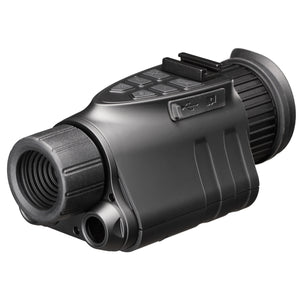
The footage was filmed with the Thermal Master DV2 handheld thermal imaging camera, which let Dan search the water in complete darkness and pick out warm animals from hundreds of metres away. The same series has taken Dan to an otter family on Mull, a starling roost and a badger sett, and each has its own behind-the-footage write-up.
Next in the series: Dan goes in search of pine martens.
FAQs
Can you see whales with a thermal camera? Yes, mainly their blows and the parts of their bodies that break the surface. Professional ship-mounted systems detect whale blows 1.5 to 3km away. Handheld cameras have a shorter range, but Dan's picked up a dolphin about 500 metres away at night and a humpback just under a kilometre away in daylight.
Does a thermal camera work in daylight? Yes. Thermal imaging detects heat rather than visible light, so it works by day as well as by night, as Dan's humpback sighting shows. Conditions still affect results, and you should never point a thermal camera at the sun.
Do whales and dolphins sleep at night? They rest, but they never fully switch off. Every cetacean scientists have studied so far sleeps with one half of its brain at a time, so the other half can keep watch and keep them breathing.
Are there humpback whales in UK waters? Yes. Sightings around Britain and Ireland have increased markedly in recent years, and humpbacks are now seen around the Hebrides and elsewhere along the coast.
How close can you get to whales and dolphins in Scotland? NatureScot's rules of thumb are at least 100 metres from whales and 50 metres from dolphins and porpoises, and 200 metres or more from mothers and calves. It's an offence to deliberately or recklessly disturb or harass any of them.